Reading marks in stone
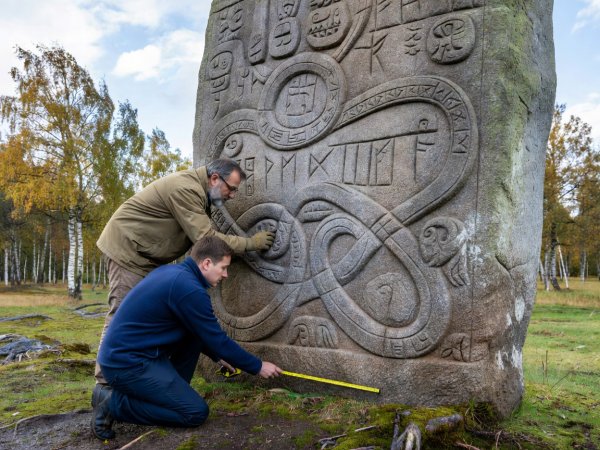
Stand before the Gripsholm Runestone (Sö 179) beside Mariefred in Södermanland, Sweden. Carved into red gneiss around 1040 CE by a mother named Tola for her son Harald—brother of Ingvar the Far-Travelled—its serpent band winds around a poetic stanza that ends grimly: "They fared like men / far after gold / and in the east / gave the eagle food. / They died southward / in Serkland."
Runes were not an arcane fortune-telling deck reserved for secret priests. They were an angular alphabetic writing system designed for carving into wood grain, bone, metal, and granite across more than a thousand years of northern history.
Why Viking Age runes use fewer letters than earlier scripts
One of the most frequent mistakes in popular media is stamping Viking Age shields or banners with the 24-character Elder Futhark (used roughly 150–750 CE, as seen on the Vimose comb in Denmark or the Kylver stone on Gotland). By the start of the Viking Age (c. 750–800 CE), the spoken language of Scandinavia underwent rapid phonetic shifts called syncope and umlaut, expanding its spoken vowel inventory.
Paradoxically, runecarvers simplified the alphabet from 24 characters down to the 16-character Younger Futhark (in both long-branch Danish and short-twig Swedish/Norwegian variants). A single rune in the Younger Futhark had to represent multiple sounds—for example, the úr rune stood for /u/, /o/, /y/, /ø/, and /w/, while the týr rune represented both /t/ and /d/. Context and spoken fluency allowed Viking Age readers to parse the words.
Three landmark inscriptions and their transliterations
1. The Great Jelling Stone (DR 42, Jutland, c. 965 CE)
Translation: "King Harald ordered this monument made in memory of Gorm, his father, and in memory of Thyra, his mother; that Harald who won for himself all of Denmark and Norway and made the Danes Christian."
Evidence note: Ordered by Harald Bluetooth, the stone’s three faces unite runic text written in horizontal lines (imitating Latin manuscript layout), a ribbon-style beast, and the earliest monumental figure of Christ in Scandinavia, entangled in vines rather than nailed to a cross.
2. The Gripsholm Ingvar Stone (Sö 179, Södermanland, c. 1040 CE)
Translation: "Tola had this stone raised in memory of her son Harald, Ingvar's brother. They travelled valiantly far for gold, and in the east gave food to the eagle. They died in the south in Serkland."
Evidence note: One of roughly 26 "Ingvar stones" in the Lake Mälaren region commemorating a disastrous Swedish expedition down the Volga or Dnieper toward the Caspian Sea (Serkland, land of the Abbasid Caliphate) that centuries later inspired the fantastical Icelandic Yngvars saga víðförla.
3. The Sigtuna Copper Amulet (U Fv1933;134, Uppland, late 11th century)
Translation: "Wolf/Thorn of wound-fever, lord of thurses [giants]! Flee now! You are found..."
Evidence note: A small pierced copper plate meant to be worn on the body to banish infection or fever. Unlike memorial stones, metal amulets from Sigtuna, Kvinneby (Öl SAS1989;43), and Ribe preserve genuine vernacular healing charms.
Interpretation Note: What did everyday people write on wood at Bryggen in Bergen?
For centuries, historians wondered whether only elite chieftains and stone-carvers could read runes. Following a fire in 1955 at the medieval wharf of Bryggen in Bergen, Norway, archaeologists excavated over 670 pieces of pine wood and bone (the Bryggen inscriptions, cataloged N B1–N B670) dating from c. 1150 to 1350 CE. They include ownership tags on grain sacks ("Thorgrim owns this"), merchant business letters ordering cod and butter, Latin prayers, skaldic love verses, and a tavern message from a wife ordering her husband: "Gyda tells you to go home" (N B149). Runic literacy in medieval towns was widespread, practical, and lively.